
Only the hum of the air conditioner at 3:30 a.m. No traffic, no taxis conversing in the cacophony of beeps, even the crows cawing is silent at this hour. Awake, mind whirring, digesting the feast for the senses served up by Mumbai, formerly Bombay. Bombay (Bom Bahia) is the pronunciation of the name the Portugese gave this city in perpetual transition during the one hundred year stint from the mid-1700s to the mid-1800s when the Brits moved in for the next one hundred years. It means beautiful bay.
On our third full day in Mumbai we hired a guide through Mumbai Magic, a service Dawn saw advertised in a travel mag. It turns out the owner of this operation, Deepa, started this business after leaving a successful career as a banker, having earned her degree from a prestigious university for finance. Deepa, according to our ‘knowledgeable lady guide’, Sandhya, has a passion for shedding a different light on Mumbai, which is not traditionally a tourist city. Deepa also has a passion for empowering women, hence her entire roster of guides is composed of knowledgeable ladies. We were delighted to learn that we had chosen an operation that gainfully employs women in a country that has some catching up to do on this front.
And Sandhya as indeed as knowledgeable as she was lovely. She has been giving tours for 22 years, and has lived in Mumbai for 35 years. She self-educated for this industry through copious amounts of reading covering everything from the Hindu pantheon of gods and what they symbolize, to the history of the city, architecture, markets and so on. The tours we paid for were an expedition to Elephanta Island and a wander through a food market in an area of the city called Matunga (people choose to live in this neighborhood for the quality of the food). The topics we discussed over the course of our full day together, however, covered a vast catalog of topics. She directed the taxi drivers that took us to Matunga from Colaba, and back to the YWCA after our food extravaganza, to take different routes through the city to also give us a broader sense of this western facing port city, termed the gateway to India.
King George V entered the stone-structure literally termed the Gateway to India built exclusively for his arrival in 1911. Mumbai is strategically located and has been a center of commerce for centuries. Shipbuilding, raw cotton, cotton mills, textiles, and now service. Sandhya pointed out the defunct stacks of the cotton mill industry as we passed by en route to Matunga. These buildings are now transitioning to residences and this is changing how communities are organized. She guided us into an example of a traditionally structured community, and momentarily away from the foodie haven in Matunga where multiple families live in a 4 story building and all dwellings open to a central square. She explained that in this structure everyone knew one another, festivals were/are communally celebrated, romances happened across balconies, as well as gossip.
Sandhya explained that Mahatma Ghandi situated himself in Bombay because he knew it was a strategic and powerful place to put his philosophy into practice to develop a base of support to resist the inequity of the cotton mill and textile industry which were structured to exploit the Indians and benefit the British. Of course now there are statues and major boulevards throughout India named in his honor. Ghandi is quoted as having said, “the world has enough for every man’s need, but not every man’s greed.” This quote was lifted and scribed with a permanent marker on oak tag and posted inside of a closed bank branch window when the Occupy Wall Street movement in Oakland called for a general strike downtown on November 2. He also said, “my life is my message.” Words to live by.
Ghandi using his intellect to stamp out injustice reminds me of the story about Shiva earlier that day in the Hindu temples carved into the volcanic rock on Elephanta Island in his honor. We were in front of an angry Shiva, sword firmly held in his right hand after having decapitated the head of a demon of darkness whose blood would have propagated more demons had it touched the earth. Fortunately Shiva has more than two hands, and was able to also catch the demon’s blood in a bowl while simulataneously ringing the bell to announce his victory. A different level of multi-tasking altogether, the symbolism depicted in this gorgeous carving created 1,300 years ago by a devoted craftsman demonstrates that with the sword of intellect, this human incarnation grants us the power to slay the demons of vice and not succumb just to instinct. We have the ability to condition ourselves through our work, intellect, asceticism to become one again with the god source.
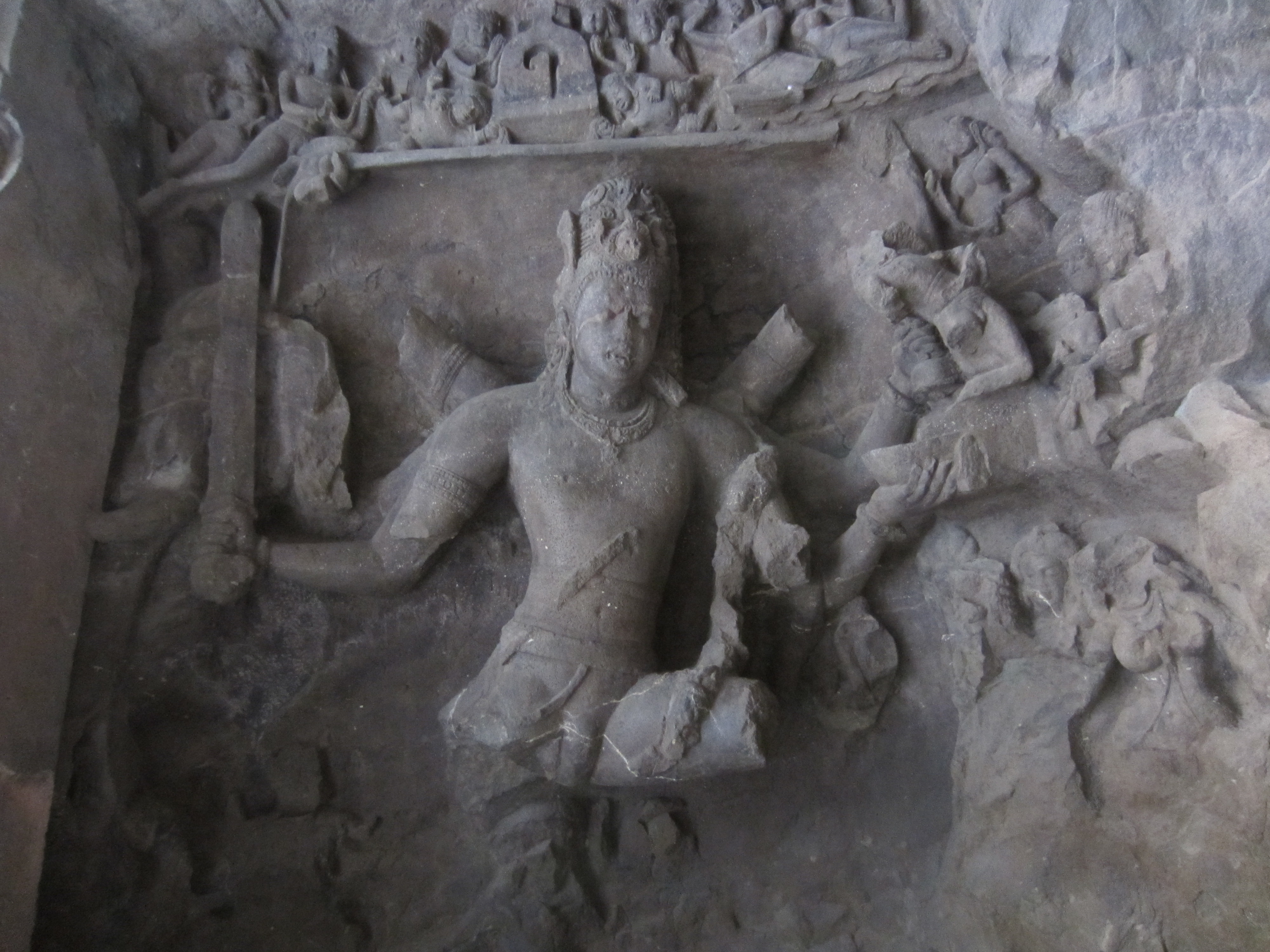
Sandhya pointed out that if you attempt to remember all the gods, goddesses, their progeny, their various incarnations, and their mounts you’re missing the point of Hinduism. A living religion that offers a panoply of accessible gods all meant to symbolically provice entrance to choosing the path of enlightenment, and away from the darkness.
Elephanta is a UNESCO world heritage site and place of annual pilgrimmage every February/March when Shiva’s birthday is celebrated. His birthday is determined by the lunar calendar, hence the lack of a fixed date. Pilgrims pay homage at the intact Shivalingum, and there are two intact lingams within the caves. The lingums look like the rounded half of an inverted capsule. Many of the carvings with human faces that populate the temple were used as target practice by boys with their toys in aother century and have lost chunks of devotional detail. Wonder how karma saw to their reincarnation? The good news is that we cycle through until we get it right.
The ferry ride out to the island was a welcome respite from the heat. It’s a funny heat in that it doesn’t necessarily feel oppressive at first, but it builds. You see people all over the city succumbing to this exhaustion and napping in a variety of positions on the ground, amidst groups or solo. Many sleep where they work in the evenings as well (i.e. in their auto-rickshaw or taxi), or a patch of dirt near where they work. It’s expensive to live in Mumbai and many have moved here for employment, but western concepts of upward mobility do not translate into this equation. This took some acclimating.
Once on the island it is a walk (or a train ride) to stone steps that lead up and up past stalls and stalls of vendors selling jewelry, postcards, books, purses, devotional miniature statues, funny t-shirts (Come to India! One billion people can’t be wrong) food, and more. We stopped for one version of an Indian burger (because it is India, you won’t find beef on the menu anywhere – in fact the bull is Shiva’s mount) of fried potato on a bun on the way down. A delicious treat made all the better by having to safeguard it from the grabby monkeys on the tarp overhead and lining both sides of the steps.
First crow just sounded at 5:50 a.m.
More on food. We had an eye-roll to the back of your head delicious seafood dinner the first night we were in downtown Mumbai at Trishna consisting of tandoori prawns, crab cooked in plenty of butter with garlic, salt and pepper, stuffed paratha and cheese naan. That was my pouty, grumpy night. Let me explain.
We had cashed in our business class voucher from Hong Kong to Mumbai and we rode in style with exceptional pampering. I stayed awake for the majority of the seven hour flight to write the Hong Kong post. When we landed in Mumbai, I was a kid-at-Christmas kind of excited – I have wanted to travel to India as long as I can remember.
Sushmaa and Suhaas picked us up and the pampering continued. We drank tea, ate snacks and stayed up until 4 a.m. engaged in riveting conversation with Sushmaa, my dear friend Richa’s mother. Richia invited me to attend her brother Suhaas’ wedding (November 27) in Goa back in July, and that’s how this whole journey started. By mid-August Dawn was on board. By Labor Day we had our plane tickets.
We were up at 8 a.m. the following morning to the sounds of pigeons nesting in the windowsill, crows cawing in the palm trees outside the window, and locals heading to get milk from the cows being tended in the area behind Sushmaa’s apartment. We had a tasty breakfast of flattened rice prepared with spices and tea before heading out to grocery shop, buy fabric, and go to the tailor to have measurements taken for the blouse I will wear with the sari I am borrowing from Sushmaa for the wedding. Dawn is borrowing clothing as well, though not a sari.
Then came our initiation to driving in India. It was an hour plus non-air-conditioned ride bobbing and weaving through densely driven roads packed with auto-rickshaws, taxis, cars, pedestrians, bicyclists, scooters, motorcycles, buses, trucks, and the occasional cow – traffic lights optional – all moving in a fluid kind of organized chaos. It’s a few days forward that I’m typing this post and there definitely seems to be a rhythm to it. Dawn loves it. Like my friend posted on Facebook – taxi drivers in India need a good horn, good brakes and good luck. Passing two accidents from Cochin to Varkala the day before yesterday was unsettling, however. Everyone rushes to attend to the injured. Our taxi driver said that he passes 3 to 4 accidents every time he drives that road and I suggested that we not be one of them. He saw to that with expert skills.
During the drive from Sushmaa’s house to downtown Mumbai, our bags were on top of the taxi for the entire trek and thanks to all the indoctrination I had been given on how to safeguard your possessions and not to trust anyone, I spent a good chunk of that drive stressing about a heist. We made it to our accommodations just fine, but I was in a mood, overwhelmed by the barrage to the senses, hot and tired. And scared. Resistance to the unfamiliar instigated a retreat into self and I wasn’t very good company. Dawn graciously permitted me the space to work it out, and I did by waking up in the middle of the night to journal in an un-air-conditioned stairwell because the guys that serve as the bellman were scrunched up on loveseats in the common areas, sleeping where they work.
Back to Matunga. The vendors buy their produce from wholesalers that truck it in. What’s unique about Matunga is the care the vendors take to display their fruit and veg. A host of recognizable produce was displayed with a variety of things I had never seen. Gooseberries as big as plums, elephant foot (root), beetlenut fronds, and the raw nut itself (used in a digestive called pan that we had as a pallet cleanser after out pitstop for an udupi feast), parts of the banana tree that I didn’t know were edible (the flower and the stalk), green eggplants, a prickly veg that is super bitter and you need to peel it, salt it to bleach out the bitter and then serve it up with mint. We also stopped in a well known silk sari shop with counters versus the sari shops we saw later along the way where women sit on mattresses on the floor while one sari more beautiful than the next is laid out in a dizzying array of choices. And gold shops too. Indians buy more gold than any other group of people, as noted by our knowledgeable lady guide.
Sandhya also pointed out the Muslim part of town on the way to the market as well as the variety of places of worship – mosques, synagogues, Christian churches, and Hindu temples. On the way back at the end of our day, she said all your wishes could be granted in Mumbai by Lakshmi on Tuesdays, at St. Michael’s on a Wednesday (after 9 consecutive Wednesdays of doing novenas), and on Fridays at the mosque where a revered Muslim man worshipped along the outside shore of Mumbai.
There’s a considerable Muslim population in Mumbai. The second evening we were in town, after a day of shopping for cotton clothing and stopping for refreshment and respites along the way, we went for a walk on Marine Drive. Clearly at this point I have moved someplace beyond the gripping fear that plagued me days before. There was a huge, well lit building a distance away and I suggested that we walk to it, assuming it was hotel, have a beer and take a taxi back. Sounded like a plan. Except it turned out the mirage on the horizon turned out to be a Muslim hospital. Going for a beer at a Muslim hospital, now that is funny.
We learned yesterday that the hospital was lit up because the benefactor of the hospital, a Muslim man, turned 100 earlier this year.
The city and my fearless travel companion are awake now, crows cawing, trucks rumbling, dogs barking, vehicles beeping. Time to dissolve into another day.
 stillsmallvoicedotnet
I can smell the curry, incense and stinky streets! Sounds like you gals are in Shivas hands.
Love your stories.
Namaste’
Nancy
Nancy – Delighted you are enjoying the stories, and yes curry, incense and stinky streets indeed. I’ve grown to enjoy the smell of burning piles of rubbish in the early mornings. Holy Cow is a great read while on this journey too.