
Today was one of four days a year when I drive from Oakland to Walnut Creek to use the lifetime of free oil changes that came with the purchase of my vehicle five years ago, provided I go to a dealership. The BART ride back to work gives me that commuter opportunity to read. This morning’s commute came with the added bonus of an overcast sky, intermittent showers and a rainbow in full bloom arching over hills blanketed with baby fresh green grass and bursts of yellow clover. The April issue of The Sun magazine was my companion, and it opened at its stapled center to offer a story titled Benedicta. There was just enough time to read this story and the poem that followed, titled Getting Ready. Both were about death, and lovely.
The mood caught me. Instead of heading straight to the office, I ventured into Cafe Madrid and enjoyed a second Americano. There was a couple with big red luggage watching the morning passersby at 20th & Broadway. The woman at the counter used the terms ‘hon’ and ‘sweetie’ when speaking with the clientele and it worked. Her endearments were a welcome reminder of our human longing for connection.
The story and poem in The Sun stirred in me. Benedicta is a story from a granddaughter who has gone to be with her grandmother’s body at the nursing home where she passed away to await the funeral home workers coming to collect the body. Her grandmother was 92. Benedicta is a woman in the hallways whose memory works in 60 second loops. She is constantly asking to be reminded of her whereabouts, the date, her name. The author, Sarah Braunstein, explores the concept of consciousness, how it leaves us all eventually.
My Nanny is 92. I am beyond grateful to have had her in my life as long as I have, never tire of her stories that evoke a different time, people I’ve never met, her joys and sorrows, loves and losses. I love her voice, watching the emotion pass over her face, and her turns of phrase. The most recent visit the week before last was hard. To see her so 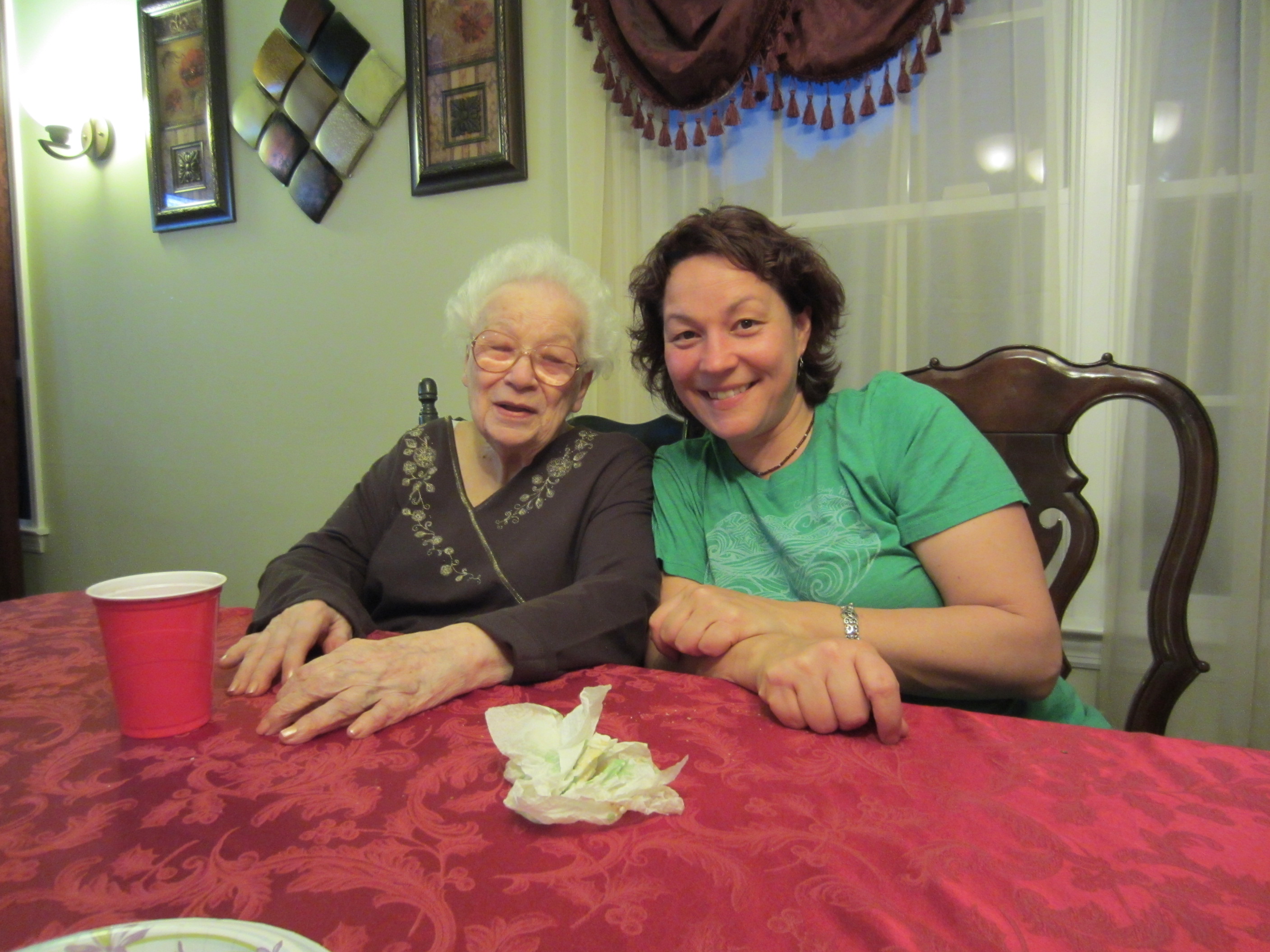 uncomfortable in her body, and now her confusion too. She has outlived all of her siblings, the majority of her friends, and her only son, my father. She has lived through nine decades of rapid change. She is tired, frustrated, and seemingly close to done. It is a full life.
Also, I think of my dear friend Richa whose grandmother, Nanima, passed yesterday. Nanima witnessed and was an active participant in the events of the same decades my grandmother passed through, though from a vastly different set of circumstances in India. I am equally grateful to have known Nanima through Richa. She was an amazing woman. A matriarch whose stories will live on in many. An attempt to capture a small fraction of her life is here.
Last weekend the web of connection was palpable in a room full of trainees being initiated into the community of volunteers that serve residents of the Guest House and Laguna Honda Hospital as part of the Zen Hospice Project. It will be a great honor to serve in this community. Our wholehearted teachers offered that loss connects us all. Grief is something we own, something we feel in our bodies as a unifying experience. We were asked to participate in one of the more profound exercises of the weekend by writing to someone we’d lost through death or separation. Then we were invited to share our grief and vulnerability with the group by reading what we’d written out loud. It was impossible for me to choose between writing to Jody or to my father, so I wrote a letter to each of them.
During my interview to volunteer with the Zen Hospice Project, I was asked where I feel grief in my body. Did it have a color? A texture? These questions cracked open the raw emotion of missing my father, and the tears flowed. I asked if there were rules around crying at Zen Hospice. My interviewer, Eric, responded with generous laughter that held me like an embrace and extended the following invitation, ‘bring all of your grief, let it be true.’
We live in a culture that doesn’t honor grief. Most employers offer a few days of bereavement pay for the loss of an immediate relative, but there’s a pervasive awkwardness around our ability to dialogue about our experiences of loss. And the more it gets stuffed down, the more feelings of being cut off set in, the potential for alienation grows. You just want someone to let it to be true. Grief is a fog that needs time to lift.
The training to volunteer with the Zen Hospice Project is much more about learning how to live than it is about dying. The service is built on the premise that everyone deserves to die surrounded by love. Ram Dass wrote the following in the preface to Stephen Levine’s book titled, ‘Who Dies?’: The new hospice movement focuses on providing a warm, supportive, and open environment for the individual undergoing the dying process. With the Zen Hospice Project, the family of the individual is also brought into the fold.
Here’s what dying in the U.S. looks like, as reported by the onsite doctor at Laguna Honda who manages the palliative care: 57% of us will die in hospitals, 17% in nursing homes, 20% at home, and 6% other. The majority of deaths are managed with clinical (or curative) care, and not palliative care. Clinical care is largely about managing the physical aspects of someone’s health, and more often than not omits the psychosocial, emotional, and spiritual components. As part of our Zen Hospice Project training, we are learning how to turn towards the dying with wholeheartedness. To trust that there is nothing that needs fixing, changing, healing or correcting. In this there is the chance of providing a container that supports the full spirit, instead of contributing to the brokenness. I can’t think of a better way to live.
The founding director, Frank Ostaseski, developed five precepts that stand like pillars throughout the training. They are:
- Welcome Everything. Push Nothing Away.
- Bring Your Whole Self to the Experience.
- Don’t Wait.
- Find a Place of Rest in the Middle of Things.
- Cultivate Don’t-Know Mind.
Again, I can’t think of a better way to live.
The weeks and months leading up the training were packed with activity. It took me until the third day of our training to fully arrive and one exercise in particular grabbed me. It involved sixteen post-it notes dispersed in sets of four different colors. On one color we were asked to write the names of four people we held dear. On another color we were asked to write four possessions we love or use daily. On the third color we were asked to write an activity we love, and on the fourth we were to write a role or a relationship we have in our lives. Then we were asked to fan these sheets of paper out before us and to take it all in. And then we were asked to choose one of each color – a person, an activity, a possession and a role. One of our teachers came around with a basket, bowed in front of us and we had to let go of this grouping. For me, the ritual around this exercise and the way in which it was conducted imparted a very real sense of loss. Then we were instructed to choose four any color for the next wave of loss. In the final round, we did not have to choose anything. There was an impulse to leave the room, or hide the post-it notes that were left. But I stayed and one of our teachers, a current volunteer, in the role of Kali randomly swiped post-it notes from us. Following each round of loss we were asked if what we were left with was enough. Vitality, vigor, planning, future – these things all leave us eventually. How will we manage?
I have built my identity around independence and activity, the doing more than the being. To do lists constantly re-surface as evidence of all these things that I’ve done. It reminds me of the last line of The Shins Simple Song, which is… ‘its such a delicate thing that we do, with nothing to prove, which I never knew.’
The next year will have its way with me, I am certain.
Dear Dad,
I miss your certitude, your confidence, and the unwavering infrastructure you gave to my life. The world without you is a different and more scary place. I could always count on you to offer up supportive statements such as, ‘get your head out of your ass,’ or ‘stop fucking around,’ or ‘Lisa Marie, you’re too deep for me.’ While you were alive these offerings infuriated me, made me bang at your door to be understood. And now, I miss your ability to pull me up out of my depths with your harsh invitations. And after you died, visitor after visitor at your services told me how proud you were of me. And the dreams that came after you died, for years, told me that too.
I would say to you now that I love you. That there’s lots of fantastic new music I wish I could share with you. That I’m figuring it out slowly, in my own time and you don’t have to worry. I’ve got bennies and a regular salary. And I’m very sorry that I didn’t call you from Ireland when it turned to the year 2000, I had no idea you were waiting for that call and I’m sorry that hurt you.
I would ask for a hug. And I would thank you for loving me the best way you knew how.
 stillsmallvoicedotnet
Excellent post…..maybe someday you can clarify “Cultivate Don’t-Know Mind” for me…..keep writing.
Beautiful Lisa. Looking forward to hearing more about your training & experiences. Although I should have known enough to not read this just before heading back in to work – tears in my eyes and all.
Thanks Cheryl and Jim. Nothing like being cracked open during the work day, huh? *)
And your Dad would say to you, “I love you, Lisa, and I am awed by this amazing person I helped create.” He would be relieved that the cheese slicing ran its course. The benefits really came from Nanny–“Get a job at the Post Office. You’ll have a pension.”
I never heard him say anything about Ireland, except “I hope she knows what the hell she’s doing.”
He always knew that you would figure it out. And you have. Beautifully. He would have been beyond proud, trust me.
Beautiful, Lisa– thank you so much for writing about your experience.
Sitting here on a gray morning, looking out at my carefully cultivated lawn and realizing that I need to focus on WHO instead of WHAT. Thanks for the reminder Lisa. Miss you and hope you’re doing well.