
Yesterday, our first day in Singapore, after a night flight, Smith Street and South Bridge Road at Nanyang Old Coffee, where one can rediscover the good taste of old Singapore traditional coffee. This is one dark and delicious cup of coffee.
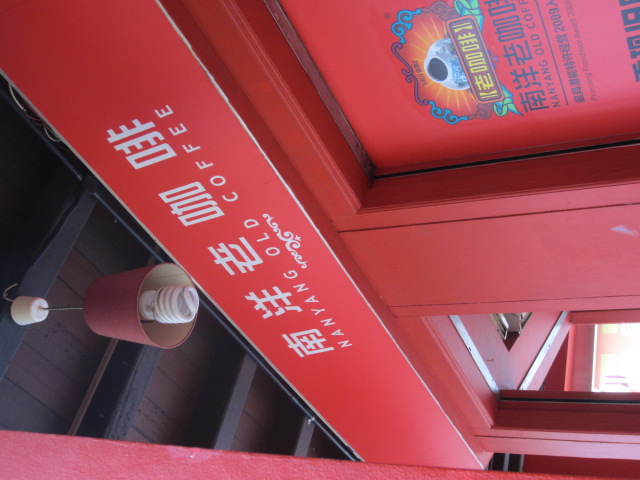
traditional Singaporean coffee
The rain that was predicted picking up its pace to a full-throttle downpour. Awnings abound to shelter pedestrians from the rain in this year-round hot and humid city. The Lonely Planet guide book offers the striking statistic that lightning strikes this city 170 days every year making it one of the lightning capitals of the world. Thunder rumbled as I was composing that sentence. This city is known for the strict standards that keep it so clean and orderly. On the immigration form you are required to complete prior to being permitted entrance to the country, red letters provide the warning that death awaits you for drug trafficking under Singapore law. Garbage cans read ‘Bin it’ and they work, we haven’t seen anything on the streets or side walks. This is a dramatic departure from India. We did get a taste of India taxi driving skills however when our cabbie, a north Indian transplant from 30 years ago, drove backwards for about 2 blocks to avoid the 2 km drive he would have had to manage due to the one-way streets to get us to the front door of our boutique hotel in Chinatown. Boutique because it is small, has a bit more character and old-world charm with its velvet furniture and fabric-like walls.
Smith Street is one of the hawker food centers in Chinatown and a few streets over from Pagoda where you can find all kinds of bling for your body and your electronics, as well as many of the items you would find in chinatown in the states, i.e. hand-held fans, chopsticks, clothing, accessories, postcards, magnets, etc.
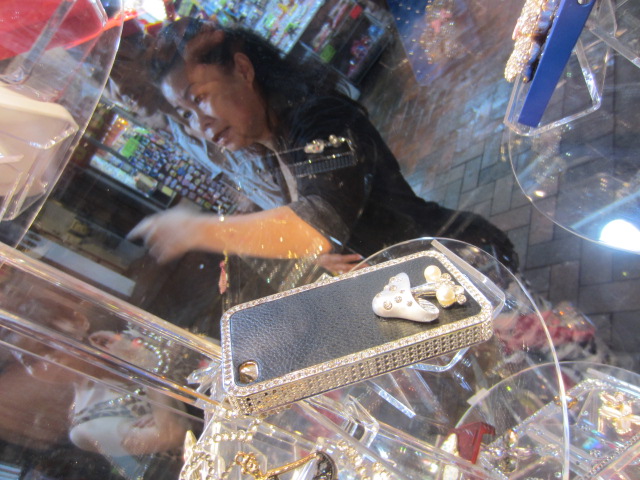
choosing the bling
While looking at a map posted outside the Chinatown MRT, a vendor chatted me up. I mentioned massage and before I knew it, he was rapidly escorting me to a reputable parlor above his shop. I was only out for a wander with no intentions of receiving body work but when I saw ear-candling on their menu I went for it. For months it feels like there’s water in my ear and with all the flying of late it’s gotten ear-itating (sorry, couldn’t resist). William, an older gentleman, was the practitioner. He kept telling me it was okay to fall asleep as he gave me a preparatory head massage. He was good, it was definitely relaxing and the intended results were achieved. It was a close space where others were receiving reflexology in the dimly lit setting with the sound of the fan and Asian influenced soothing spa sounds. Drifting along, the sound of the sea from the last seven days at Palolem Beach in Goa still rocking me to an internalized soundtrack of ebb and flow. The other soundtrack from Goa is the light techno ts ts ts ts ambiance set by the establishments along the sea.
Today, December 1
Just tore off the baggage tags that marked our travel from Goa to Singapore through Mumbai (MUM to SIN). Tomorrow evening the bags will be tagged for the final passage from Singapore through Hong Kong to SFO. Sometimes it feels like we’ve been traveling for a month, and other times it feels like just the beginning. Our browned skin is slowly returning to its natural color and the ‘mhendi‘ is growing more faint by the day.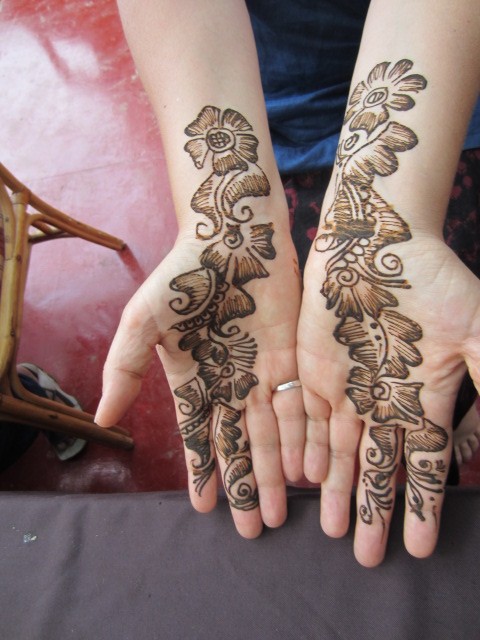
Mhendi is the application of henna on the hands and feet in 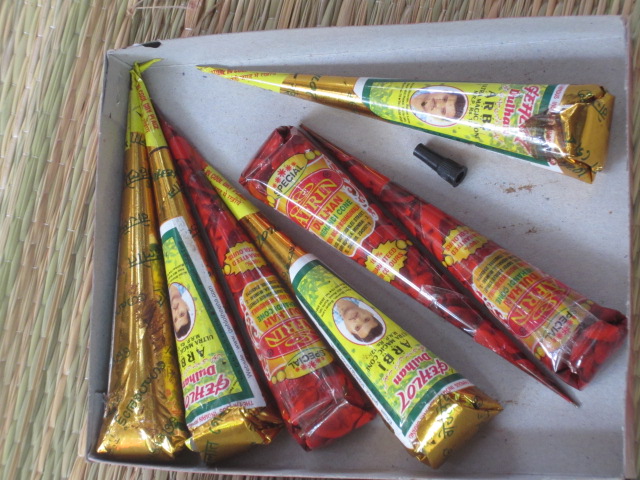
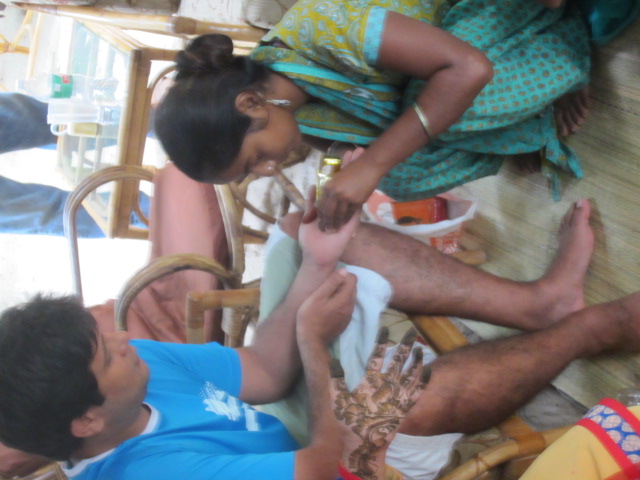
 preparation for celebrations in India. Mhendi comes from Sanskrit and is an ancient Vedic custom symbolically representing the union of the inner and outer sun, meant to awaken the inner light. The groom, Suhaas, also had the likeness of a sun applied to both of his palms, as well as being rubbed down by turmeric by his family and friends to awaken his inner light prior to his embarkation into marriage, one of 16 rites of passage prescribed in the Vedas and performed by a Hindu priest, the purohita. While the mhendi is applied to the bride and female folk the day before the wedding, the women sit in a circle around mats on the ground with the mhendi application at the center. Songs are sung in what is traditionally a kind of sing-off between two camps. Each camp is supposed to have a song ready to go as the other winds down, picking up on the prominent sound from the song just sung in a friendly competition.
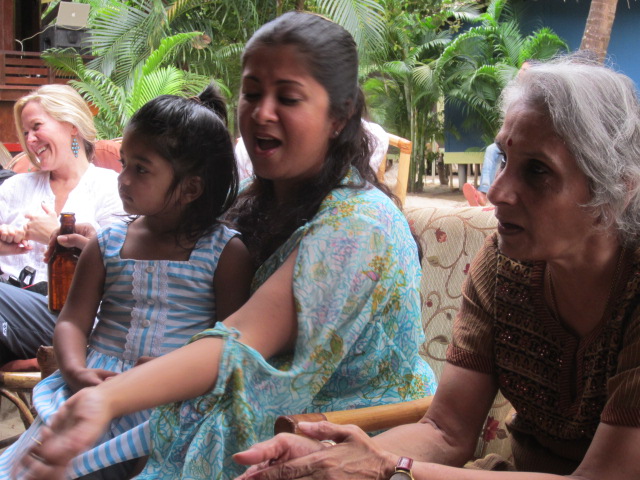
Richa singing a song from our camp
The bride to be, Ratnabali, is from

Sushmaa setting the beat for her camp
Calcutta, the capital city in the state of West Bengal. These days it is spelled Kolkata. The day after the wedding I was fortunate to have the opportunity to speak with Ratnabali’s brother, Dwijottam, who goes by Dwijit, pronounced digit. Dwijit provided wonderful insights, context and history for many of my questions, curiosities and observations born of this trip. He explained that many of the songs initiated by the attendees from Calcutta during the mhendi song circle were political in nature, and that in general people originating from Calcutta are sometimes characterized as party-poopers because of this proclivity. The way he described the current state of the de-industrialization and economic impacts on Calcutta, the more it sounded like what has happened in cities like Detroit. He agreed with this comparison and went on to say that despite this decline and the extreme poverty, there is a strong academic vein in Calcutta that you will see represented in the sheer volume of bookstores and in the philosophical discussions that happen throughout the city. The city is known for its revolutionary history and has produced figures known the throughout the world.
The matriarch within Richa’s family is Prakash Devi Sharma, referred to by most as Nani Ma, she is Sushmaa’s mother, Richa’s grandmother. She is Punjabi by birth and has covered much territory in her 88 years of life, initiated by the transition to India’s independence. She has a generous, open-minded, and revolutionary spirit and is an inspiration every day to her family and many others. At the age of 16 she got involved in India’s move towards independence as a freedom fighter. She married and raised 5 children. She has had 5 careers. She does not like to sit idle and wants to be involved in everything. She is always dressed to the nines. She reminds me a lot of my own grandmother and inspires a great affection.
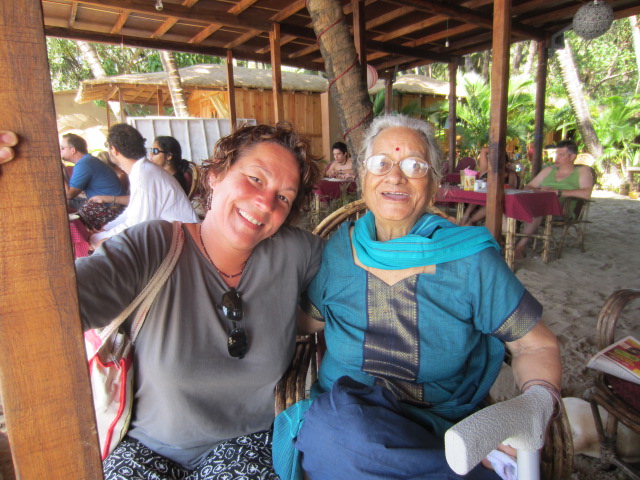
me with Nanima
Back to the mhendi, someone told me that the darker the henna takes to your palms, the more you’re mother in law will love you. The application to the palm does indeed grow darker as the colorant in the henna mixes with the keratin in the skin, naturally more concentrated in the palms. After application you have to keep the hennaed limbs still until it dries and begins to fall off naturally. Ideally twenty-four hours. And since there was a party to get to that evening, the majority of us gave it an hour before accelerating the process in various ways that did not include water because that would initiate the fading. Lunch was served just as the designs were done on my forearms and fingers so while my hands were in the air, Richa fed me (and two other friends who had traveled from the states) a plate of food with her hand in a generous act that felt like the ultimate in nurturing. Mhendi also became a commerce that served to invite safety and conversation during our travels to Singapore yesterday. The woman who inspected my passport and paperwork in Singapore met me with a smile and asked questions about the wedding.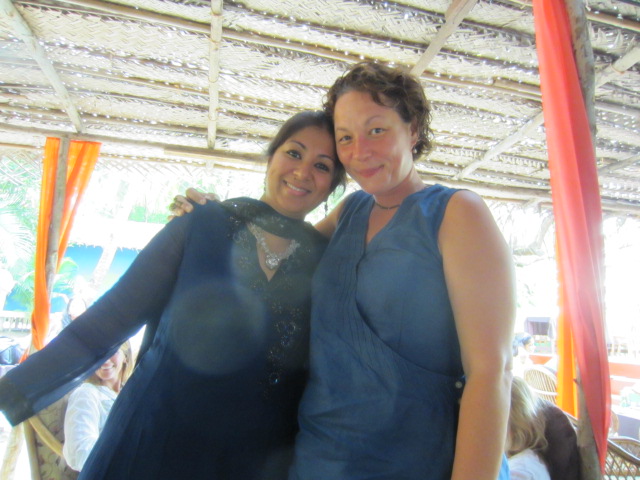
Perhaps the degree of darkness on the palm applies more immediately to the morning after application, in which case my mother-in-law and I would have gotten along famously. However, since I don’t have a mother-in-law’s love to win or lose, the fading application and dwindling anti-malaria pills symbolize the return to life as I know it most days of the year, when I am not traveling and having adventures off the beaten path elevating me to a heightened state of awareness and appreciation for this life. Working on that. On the subject of anti-malaria pills, Dawn made the rather hilarious discovery as we were about to take off from Goa the day before yesterday that she has been dipping into her anti-anxiety pills instead of the anti-malaria pills for a good chunk of his trip. For the entire week we were in Goa, she slept like a baby and was regularly perplexed with the fact that she was content to stare at the sea for hours while experiencing a dearth of the ‘big thoughts’ that usually accompany journeys like the one we have been on.
Symbolism plays heavily into the customs and traditions leading up to and represented within the actual wedding ceremony. Stories from the Vedic scriptures inform the ceremony and most of them have to do with the bride and groom’s responsibility to each other, their extended families, and of course their yet to be produced but assumed children. Suhaas’ father, Sudhir, performed in the role of the purohita. His combined skills as a performer, natural storyteller, and scholar of the scriptures afforded everyone at the ceremony entrance into a more meaningful experience of the union taking place.
Sudhir started out by telling us we all played an essential role as witnesses to the commitments Suhaas and Ratnabali were about to make, and if at any time in their lives together they went astray, our job was cut out for us to remind them of the way back. The ceremony involved a fire, burning herbs, a symbolic walk around the fire, exchanges of gorgeous floral garlands like the rows of garlands we 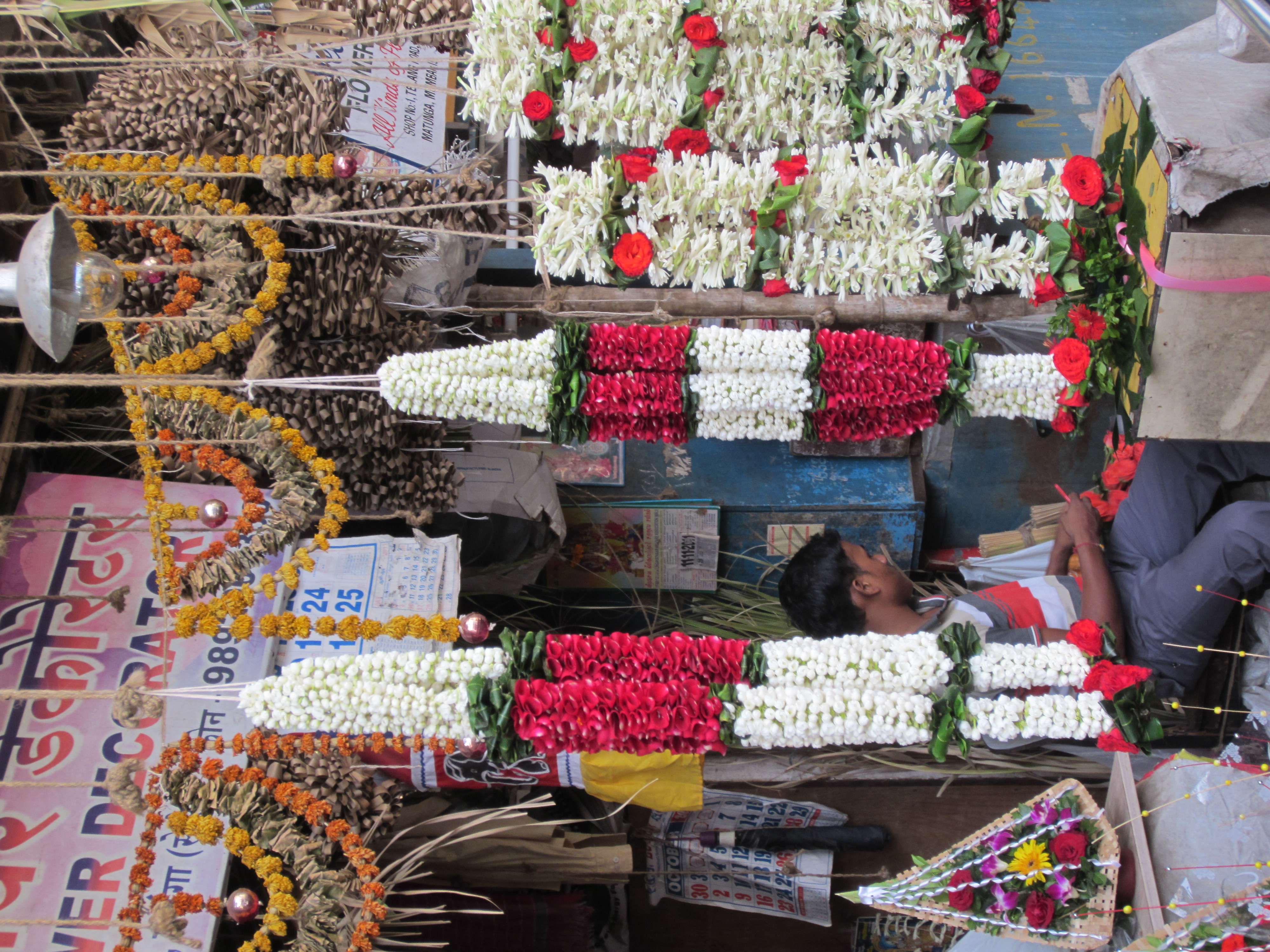 saw for sale at the Matunga market in Mumbai amongst all the family members, tying together of the bride and groom’s wedding garb, and ultimately the pronouncement that they were man and wife. Both bride and groom were carried to the ceremony by the closest of kin. Everyone I spoke with, including the resident Indians, no matter their state or city of origin, said that the explanation that was part of this ceremony was unique. Typically, the bride and the groom are off in a corner while the rites are performed unintelligibly to those present and the guests, typically quadrupled in size to this ceremony, are milling around waiting for the party to start.
The restaurant area of Dreamcatcher had been transformed during the day to be the site of the ceremony.  Furniture re-arranged or removed, strands of yellow and orange marigolds wrapped around branches, banisters, and buildings. The furniture was removed from the Forget-Me-Not cottage immediately next to the restaurant to be the sit-down, cross-legged-on-the-floor location for the
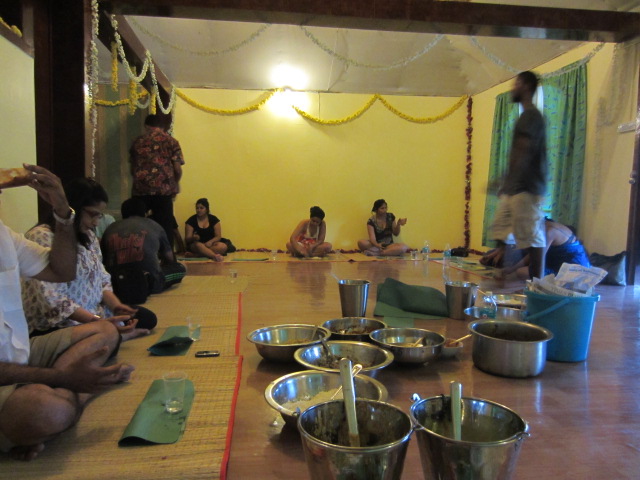
southern Indian style feast
 traditional southern Indian feast that was served for lunch with a banana leaf as a plate and only hands for utensils. Strings of white bulbs brought light to the evening proceedings until the power went out. It wasn’t uncommon to experience power outages during our travels while in Goa and Kerala. Usually brief, they were only a nuisance when they happened in the middle of a photo upload to Facebook, or in the middle of a post to the blog. The power outage during the ceremony was prolonged and served to add to the magic, making it more intimate and elemental. The occasional flashes of lightning or gentle showers added excitement from the depression over the Arabian Sea that would bring the tide crashing into restaurants and livelihoods later that evening. A few of us had intentions to cool off in

in the wake of the depression over the Arabian Sea
the sea around midnight until we walked to the shore and saw that the sea had swallowed the thin band of beach that usually allowed passage in the evenings.

threatening sky before the storm
The fire at the center of the ceremony had been lit by the time the power went out and for a significant period of time, the only scene fully illuminated was at the center of the platform over the river that lead to the sea where Suhaas and Ratnabali made their promises to one another.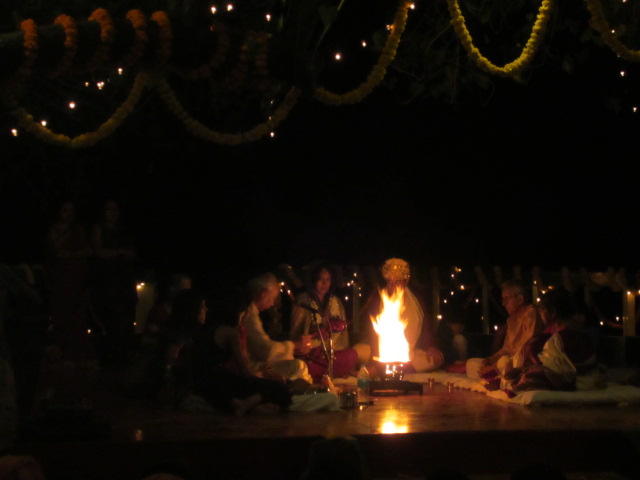
There were many non-traditional elements and interpretations of more practices typically part of the build-up to and culmination with the wedding ceremony. The night before there is usually a gathering where folk songs are sung and a meal is served. This was interpreted as a party by the sea further down the stretch of Palolem Beach on a rise that was part of another establishment that had a large covered open-air gazebo that became the setting for a talent show and numerous performances. Two of Suhaas’ nieces danced to contemporary Indian songs that will be in my digital library as soon as I get home, including Sheila Ki Javani, doing some fantastic Bollywood moves. Suhaas’ brother, Sourabh, put together a slideshow of images telling the story of Suhaas journey to that day which included an opportunity for his Bahrain contingent of friends to dance in a circle around the grooms parents, Bollywood-style, to honor them. There was an impromptu rendition of ‘if you’re happy and you know it’ with the lyrics changed up around the supplanting of the word for horny to replace happy and performed by three of Ratnabali’s friends that she knows from theater. Richa was the emcee. The final gig was Suhaas performing a few songs with his friends that they’d rehearsed for a few hours earlier that day. Then the feast. Then the walk back to Dreamcatcher along the beach.
Ratnabali’s father congratulated the couple the day following the wedding for the madness that inspired their choice to hold the ceremony in this place, absent of convention. He summed it up by saying it was the best of god. It was. It also made for a remarkable climax to this journey, in addition to being the originating instigation. There are no words to express my gratitude for being brought into this ceremony with these people in this country where I have wanted to travel for more than half of my life. And I got to wear a sari! I realized the night of the wedding that I never imagined myself in a wedding dress, but I have always wanted to wear a sari.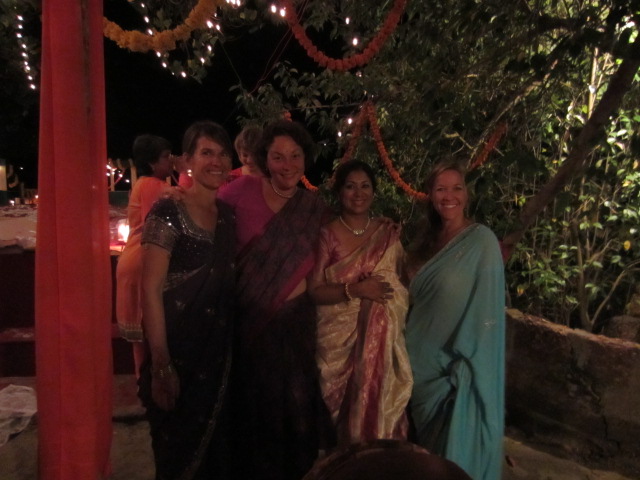
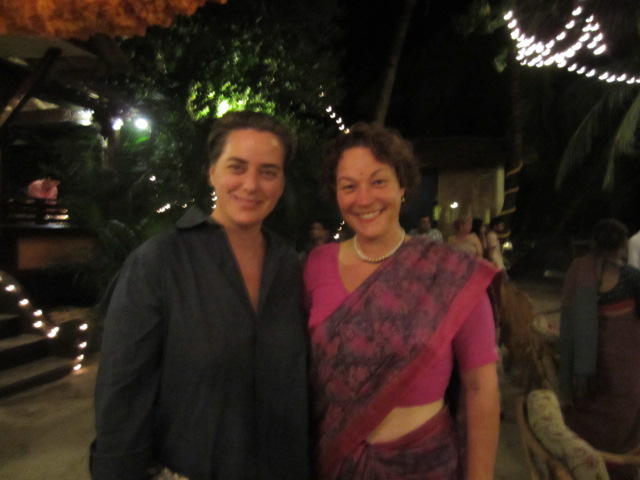
In a little over twenty-four hours we will be heading to the airport for home. Last night we fed ourselves on hawker fare and experienced the toothless nibbles of garra rufa fish on our feet and hands, referred to as fish therapy.

Maxwell Hawker Center
We shared a couple of Tiger beers and people watched on Pagoda Street. Later this evening, we plan to experience the night safari and have some black pepper crab. I use the word ‘plan’ because Dawn is having another stomach upset today from the ribs she ate last night. She has slept most of today while I have worked on this post and had a couple of Singaporean coffees. 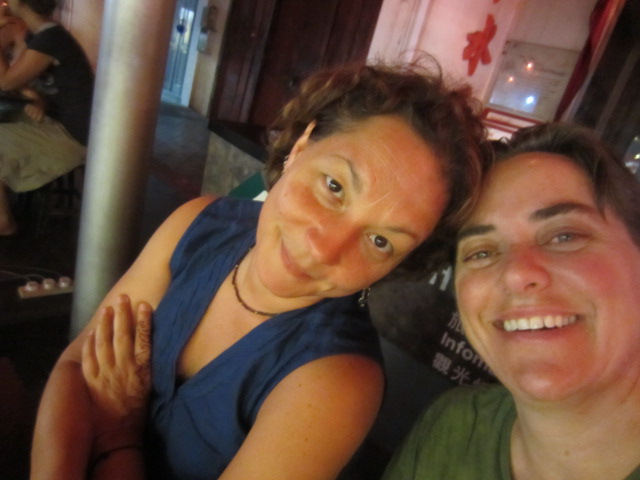
Reading Holy Cow, written by Sarah Macdonald, while traveling through India added a dynamism to this trip. Her hilarious mix of irreverent observations with details in response to her own soul-searching romp through the religions she encountered while traveling in India has deepened my experience and understanding. The chapter titled The Big Pot Festival (double entendre and reference to India’s Kumbh Mela) provides her filter and an intro to Hinduism. I quote, “Hinduism is a faith of almost infinite diversity. Yet the broadest, most complicated religion on the planet actually caters brilliantly to the individual.” A few paragraphs later, “I like your Jesus and such, and there’s no doubt he was a great sadhu, most likely trained in India, but you know, he was wrong about God. God is not a judgmental giant sitting up in heaven, it’s a force with us all — we are lightbulbs in the electrical system of the universe.” That, my friends, is a cosmology I can reckon with.
On the plane from Mumbai to Singapore I watched some Bollywood videos and a dramatic film titled Dhobi Ghat, an overlap of stories set against the Mumbai landscape, including Elephanta Caves, and it caused quite a stir in me. My love affair with India will continue, I suspect. Not to mention the Kashmiri men with their dark eyes, long lashes and salesmanship skills. Dawn is convinced that if I travel to Kashmir the only way I would ever leave is by physical extraction. Younger guys kept flirting with me throughout the trip too, regularly showing disbelief that I was 44.
We shared our accommodations in Goa with many a creature, frogs in the bathroom, moths and other insects outside the mosquito net, 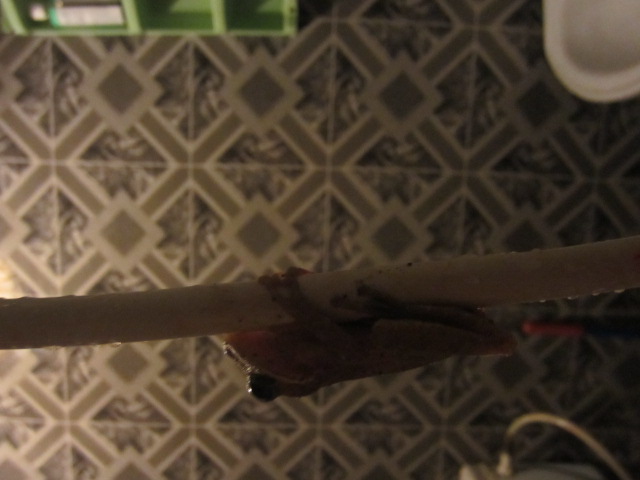 including something that looked like a snap pea, monkeys screeching and crashing through the trees outside. A dog escorted us all the way home from a fitting and delicious final meal of king prawns, snapper and chicken prepared tandoori- style at a restaurant called Dropadi along the sea with Richa and Kash our
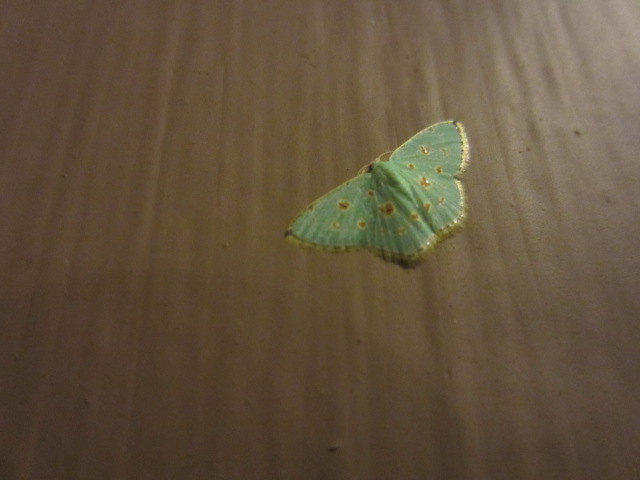
tiny and beautiful
last night in Goa. That dog got punked out by every other territorial dog along the trek home and would most likely have the same experience when he walked back. The dogs along Palolem Beach definitely hang in defined posses and have their own caste system going on. It got to the point where I didn’t even flinch to take a picture of another cow in the road, like not just on the side of the road, but full-on lying in the middle of the road. We really bonded with the guys that took care of us in restaurants and cyber cafes on this trip and saying goodbye was hard. Without fail, their goodbyes always included a genuine expression of their hope we would be back next year. I hadn’t made an emotional connection to these words until that last line. The tears are welling up, and I need to get out of this Singaporean cyberspace to see if we’re heading to the night safari. Plus the rank baby-poop smell of durian fruit is getting to me.

posted by the elevators in our hotel
Have you ever watched the way babies sleep? Their little limbs and neck all floppy in a whole body surrender? The build-up and residue of stress not yet introduced, they haven’t yet amassed the layers of protection we all tend to assume in our structures of origins, family or otherwise. We craft our mask with some idea of who we’re supposed to be, or need to be, out of sync by degrees with the original self. Then, if you choose a path towards re-integration or have a taste for self-awareness, perhaps you find some tools, disciplines, practices, support to dissolve again into that surrender for brief spells of time, no separation or resistance, just an acceptance of what is. This is the state of being, not mind, I arrived at by the end of the journey and particularly the week at Dreamcatcher on Palolem Beach in a cottage called Bliss. Whole-body happy. 
 stillsmallvoicedotnet
Beautiful post, Lisa. Thank you!
Safe travels xxx.